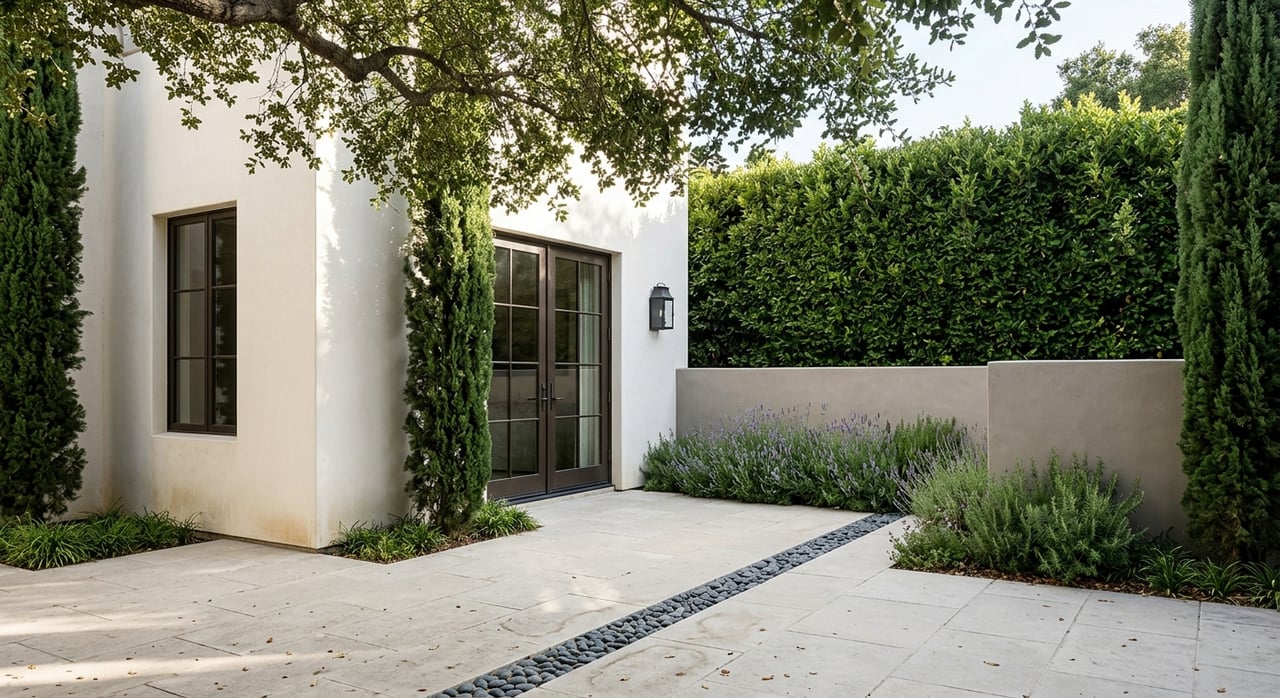
Privacy in Atherton is rarely just about square footage. On one estate, a deep setback and mature tree canopy can make the home feel quietly tucked away. On another, a wide but more exposed parcel can feel far more visible from the street and neighboring properties. If you are comparing homes in Atherton, understanding the lot itself is often just as important as understanding the house. In this guide, you will learn how lot shape, slope, setbacks, trees, and screening rules can influence day-to-day privacy and long-term property use. Let’s dive in.
Why lot profiles matter in Atherton
Atherton’s planning framework is designed to preserve a scenic, semi-rural, wooded residential character with open space and heritage trees. The Town also notes that most of its land is already developed, which means buyers are usually evaluating existing parcels rather than broad new development opportunities.
That context matters because privacy in Atherton is often created by the land around a home, not just the home itself. Parcel geometry, setback depth, topography, and established landscaping can shape how sheltered or exposed a property feels.
The Town’s housing materials describe two single-family residential districts: R-1A with one-acre lots and R-1B with 13,500-square-foot lots. For many buyers, that means the practical value of a property comes from the buildable envelope and the visual buffer it creates.
Privacy is also a planning issue
In Atherton, privacy is not just a personal preference. It is also reflected in local review standards.
Under the Town’s special structures permit standard, the Planning Commission may approve certain height exceptions, accessory structures, and other regulated items only when the project will not negatively affect neighboring properties with respect to privacy and view, and when landscaping and other development standards are met. That gives privacy a real code-level role in how some properties can be improved over time.
How lot size and slope affect privacy
A parcel can look generous on paper and still feel constrained in real life. In Atherton, subdivision standards connect minimum lot area, width, and depth to average site cross slope, which can influence both usability and separation.
Here is the current slope-based framework described in the Town code:
| Average cross slope | Minimum lot area | Minimum width | Minimum depth |
|---|---|---|---|
| 0% to 19.9% | 1 acre | 175 feet | 200 feet |
| 20% to 34.9% | 2 acres | 200 feet | 200 feet |
| 35%+ | 5 acres | 300 feet | 300 feet |
For you as a buyer, slope can affect much more than appearance. It can change how much of the parcel is realistically buildable, how structures sit on the site, and how much land remains as a natural privacy buffer.
A flatter parcel may feel easier to plan and more predictable for outdoor use. A slope-constrained lot may offer stronger separation from neighbors or the street, but it can also bring more design, grading, and preservation considerations.
Setbacks shape the daily experience
In Atherton’s R-1A standards, interior and corner lots are treated the same for main-building front and rear yards, with 60-foot minimum setbacks for each, subject to a narrower exception for some older recorded lots. These deeper setbacks can play a major role in how private an estate feels from the street and from adjacent parcels.
Side-yard setbacks also matter. The Town’s guidance says side-yard measurement is based on lot width, and lots greater than 200 feet wide have 50-foot side-yard setbacks.
That usually means wider parcels create more distance between homes. At the same time, they can also create larger no-build zones, which affects where the house, guest structures, or outdoor living areas can actually be placed.
Interior, corner, and flag lots
Not all large lots function the same way. The parcel type can strongly influence privacy, access, and how the home relates to the street.
Interior lots
Interior lots often provide the most straightforward relationship between the house and its neighboring properties. If the parcel also has strong side setbacks and mature landscaping, it may offer a balanced sense of openness and seclusion.
Corner lots
Corner lots can feel more exposed because they interface with more than one street edge. Even on a large parcel, that added frontage can reduce the sense of enclosure unless the site has strong existing trees, fences, gates, or other permitted screening features.
Flag lots
Atherton’s SB 9 objective standards say flag lots must have a minimum access width of 20 feet. The Town defines a flag lot as one that gains street access through a private driveway or access area that does not otherwise meet normal frontage requirements.
For some buyers, flag lots can be appealing because the main home sits farther from the street. Still, it is smart to look closely at driveway width, turning movement, utility placement, screening, and whether the access strip feels private or more like a corridor.
Trees and screening often define privacy
In Atherton, trees are not just aesthetic. They are often a core part of a property’s privacy profile.
The Town requires landscape screening for new construction projects to reduce the impact of structures on neighborhoods and preserve the individual privacy of homes to a reasonable degree. Screening is generally required in front, side, and rear yards, but front yards contiguous to a street are exempt from screening.
That exemption is important. It means street-facing privacy often depends heavily on existing tree lines, fences, gate placement, and what can be added within Town rules.
The Town’s current checklist says required screening must be sized so the structure is adequately screened within 3 years of installation. For non-hillside lots, the required installation uses at least 24-inch-box trees and shrubs, while hillside lots require at least 36-inch-box trees. Both are expected to mature to about 22 feet.
Heritage trees can be a major factor
A mature canopy may be one of the most valuable privacy assets on an Atherton parcel. It can also be one of the most regulated.
Atherton’s heritage-tree ordinance applies to certain qualifying trees, including some oaks anywhere on a lot once they reach a 48-inch trunk circumference, as well as other qualifying trees outside the main buildable area. Heritage trees must be shown on plot maps for certain applications, and a removal permit is required before removal.
The Planning Commission must consider whether tree removal is contrary to the Town’s general-plan purpose, including scenic beauty, health, safety, welfare, and the long-term tree cover of the site. In plain terms, if a property’s privacy depends on mature trees, you should not assume those trees can be easily removed, heavily pruned, or replaced.
The Town’s screening checklist also says new trees and shrubs should be placed 3 times their distance away from heritage trees, and protective measures for heritage trees must appear on plans. During construction, the Town requires tree preservation fencing with a 6-foot-high, minimum 12-gauge chain-link fence on 2-inch galvanized posts, and quarterly arborist reports are required for construction sites.
The right-of-way can change the street edge
Another detail buyers sometimes overlook is the difference between the legal lot line, the frontage strip, and the public right-of-way. In Atherton, the Town says the right-of-way is generally the area between the front fence line and the edge of the paved street, and improvements in that area are the responsibility of the adjoining property owner.
This matters because the visual experience from the street may include land that is not the same as your privately usable front yard. It also matters because any work in the right-of-way, including driveway work, utility installations, landscaping, or tree work, requires an encroachment permit.
How to evaluate privacy during due diligence
When you tour an Atherton property, it helps to think beyond finishes and room count. A home’s privacy value may come from the parcel itself, the existing vegetation, or a combination of both.
The Town’s eTRAKiT portal includes parcel-specific planning data such as zoning, General Plan designation, assessor lot size, and floodplain information. That makes it a useful starting point when you want to verify what you are seeing on site.
Here are smart due diligence questions to ask when comparing estate properties:
- Is the parcel an interior, corner, or flag-lot configuration?
- How does the lot shape affect usable private yard area?
- What is the recorded lot width, and how do setbacks shape the buildable envelope?
- Is the site flat enough to align with the baseline one-acre, 175-foot-width, and 200-foot-depth pattern, or does slope trigger a different standard?
- Are there heritage trees on the parcel, especially near the buildable area?
- Is existing landscape screening already approved, or would future work need Town Arborist review?
- Would planned driveway, gate, fence, planting, or utility work fall in the public right-of-way?
- If you are considering a remodel or rebuild, could a special structures permit be required because of height, accessory structures, or privacy and view impacts?
- Which trees, hedges, and berms create the current privacy profile, and can they realistically be preserved during construction?
What this means for Atherton buyers
The biggest takeaway is simple: in Atherton, privacy is a site-specific asset. Two homes with similar square footage can live very differently depending on lot width, corner exposure, slope, tree protections, screening requirements, and the amount of frontage between the residence and the street.
That is one reason careful parcel review matters so much in this market. When you understand how the land functions, you are better prepared to judge not just how a property feels today, but also how it may perform over time if you plan to remodel, expand, or simply preserve what makes it special.
If you are weighing estate properties in Atherton and want a discreet, informed perspective on how privacy, parcel configuration, and long-term property potential intersect, the Buljan Group is here to help with a confidential consultation.
FAQs
How does lot shape affect privacy at a home in Atherton?
- Lot shape can influence how far the home sits from the street, how much side-yard separation you have, and whether outdoor areas feel enclosed or exposed.
What should buyers know about flag lots in Atherton?
- Flag lots must have a minimum 20-foot access width under the Town’s SB 9 objective standards, and buyers should closely review access, screening, utilities, and the feel of the driveway approach.
Why do trees matter so much for privacy on Atherton estates?
- Mature trees often provide a major visual buffer, but heritage trees are regulated, so you should verify whether important screening trees can be preserved, pruned, or removed.
What is the Atherton right-of-way and why does it matter?
- The Town says the right-of-way is generally the area between the front fence line and the edge of the paved street, and work there often requires an encroachment permit.
How can buyers verify parcel details for an Atherton property?
- The Town’s eTRAKiT portal is designed to help confirm parcel-specific information such as zoning, General Plan designation, assessor lot size, and floodplain status.